
About
BACKGROUND
Water scarcity and the increasing pressure on water resources due to climate change, population growth, and urbanisation pose significant challenges for sustainable water management.
Concept
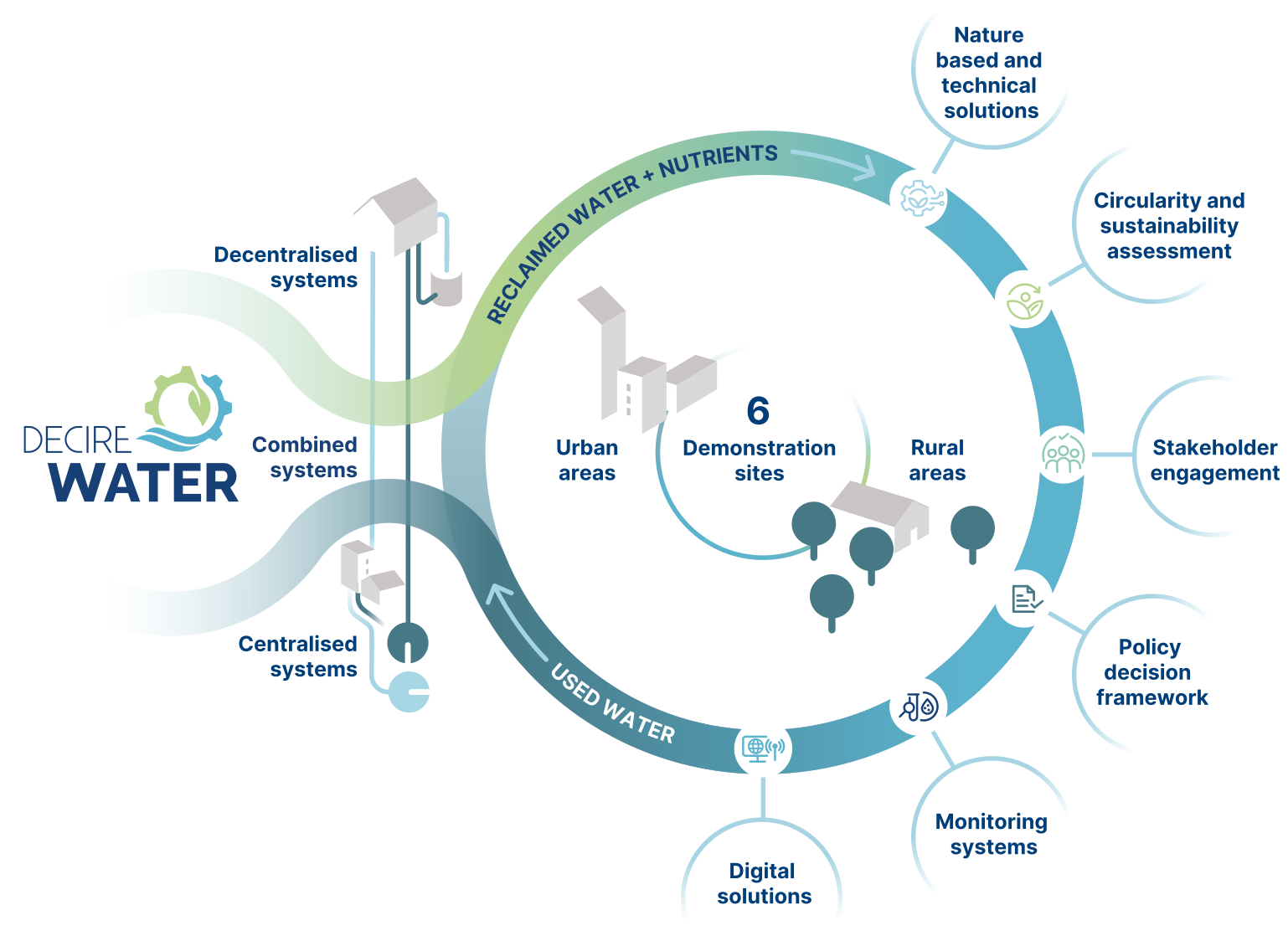
By integrating cutting-edge technologies like real-time monitoring and nature-based and technical solutions across six demo sites in Europe and South Africa, DECIRE-WATER empowers communities and industries to achieve greater resilience and adaptability in the face of water scarcity and climate change.
The demo sites are located in different geographic and climatic regions and cover rural and urban conditions.
DECIRE-WATER’s decentralised and circular water and wastewater management technologies will enhance and transform water security, public health, social well-being, biodiversity, and climate adaptation.
Especially through strong stakeholder engagement and scientific contributions (e.g. life cycle assessment), DECIRE-WATER will ensure that its solutions are scalable, adaptable, transferable, and aligned with key EU policy priorities.
Work plan
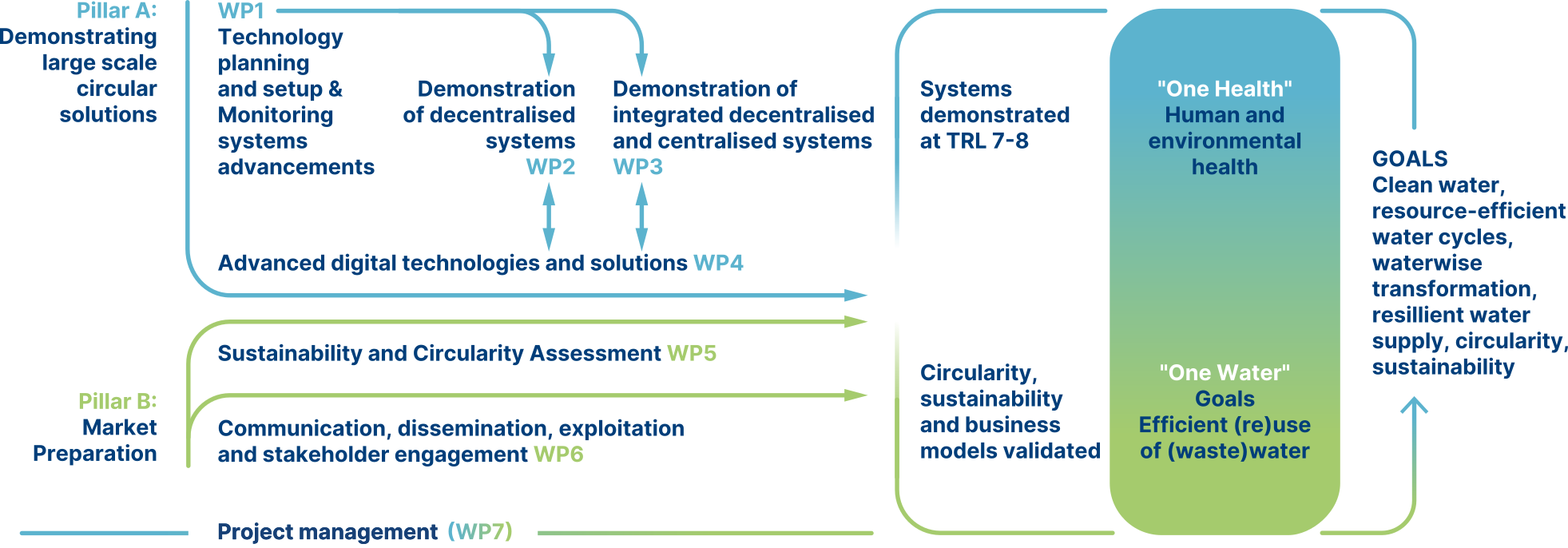
DECIRE-WATER will
- develop and demonstrate innovative technologies for circular water management at six demo sites across Europe (Germany, Greece, Poland, Spain) and South Africa – tailored to different geographic, climatic, and socio-economic conditions,
- integrate digital tools and advanced monitoring solutions for efficient and safe reuse of water resources, bringing together the “One Health” and “One Water” approaches,
- promote sustainable water management, including water and resource recovery, energy savings, and stormwater management,
- create strategies for the market uptake of the DECIRE-WATER technologies, including stakeholder engagement, policy frameworks, and business models for public-private partnerships.
Consortium
Our consortium consists of 15 partners, ranging from renowned education and research institutes, water utilities, industrial leaders in water treatment and digitalisation, to stakeholder engagement and exploitation experts.
Find out more about about our partners and their contribution to the project.

Digital solutions

The Karlsruhe Institute of Technology (KIT) is one of Germany’s leading higher education and research institutions, recognized as University of Excellence.
KIT participates with the Water Technology Department of the Project Management Agency Karlsruhe (PTKA). The department focuses on the analysis, design and support of national and EU-funded projects that promote the efficient use and protection of water resources. Its main goal is to ensure sustainable water management for a growing population, improve wastewater treatment, address health-related aspects, and increase public awareness of water and environmental sustainability.
Contribution to the project: KIT is administrative coordinator and contributes to WP4, particularly the development of a digital data infrastructure and dashboards for wastewater quality control, including health-related parameters.
Karlsruhe, Germany

Technical and nature
based solutions

Circularity and
sustainability
assessment

Monitoring
systems
Digital
solutions
The RPTU University of Kaiserslautern-Landau is the technical university of the state of Rhineland-Palatinate in Germany. As a place of internationally visible research and teaching, it focuses on engineering and natural sciences, humanities and social sciences.
RPTU participates with three Chairs in DECIRE-WATER: “Resource-efficient Wastewater Technology”, “Resource Recovery from Wastewater”, and “Urban Water Management”. The focus in to develop innovative solutions for a sustainable urban water management and to advance circular economy. This includes enhancing treatment performance, maximising the recovery of resources like water, nutrients, and energy from wastewater, and developing holistic concepts for resilient urban water infrastructure.
Contribution to the project: RPTU holds the scientific coordination of the project, defining DECIRE-WATER’s research strategy and ensuring the quality of its outcomes. The team is strongly involved in developing a web application for integrating decentralised and centralised wastewater infrastructures and leading WP1, as well as in planning and operating demo sites 2 (South Africa) and 5 (Stuttgart), where innovative strategies will be implemented and validated, bridging the gap between research and real-world application.
Kaiserslautern, Germany
Technical and nature
based solutions
Monitoring
systems
Digital
solutions
The University of Innsbruck (UIBK) is the largest educational and research institution in Western Austria.
UIBK participates with following Departments:
- The Department of Infrastructure focuses on sustainable urban water management, integrating nature-based solutions, rainwater harvesting, and information and communication technology-based control strategies.
Contribution to the project:
With the development of a machine-learning based early fault detection and of
real-time control strategies for the smart rainwater harvesting unit in demo site 5, we mainly contribute to WP4.
- The Institute of Microbiology has a long tradition in environmental microbiology, fungal taxonomy and biotechnology. Upgrading and recycling of biomass-based wastes and the microbiology of the wastewater treatment process have become a strong research focus.
Contribution to the project: We will develop a workflow for testing pandemic parameters and AMR genes in wastewater from centralized and decentralized demo sites, allowing the prediction of potential pandemic threats and the spread of antibiotic resistance. Additionally, we are responsible for testing the water quality for hygienic parameters. We mainly contribute to WP1.
Circularity and sustainability
assessment

University of Chemistry and Technology, Prague (UCT) is one of Central Europe’s leading universities in chemistry, chemical engineering, and environmental sciences. It combines a strong tradition in applied research with a focus on innovation and collaboration across academia, industry, and public sectors.
UCT’s research covers diverse areas, including material science, biotechnology, and environmental protection. The university promotes interdisciplinary collaboration to address global challenges related to e.g. energy, resources, and water. Through its scientific excellence and strong links to industry, UCT contributes to advancing knowledge and developing solutions for a more sustainable and resilient society.
Contribution to the project: Within the project, the UCT leads Work Package 5, which focuses on a comprehensive sustainability assessment of the project pilots. Two UCT departments contribute to this work: the Department of Sustainability and Product Ecology (SUPRE) conducts the environmental Life Cycle Assessments (LCA), while the School of Business carries out the Life Cycle Costing (LCC). Together, they support the development of sustainable and scalable wastewater management solutions.
Prague, Czech Republic

Monitoring
systems
Circularity and
sustainability
assessment

Universitat Politècnica de Catalunya (UPC) is one of Europe’s leading technical universities, recognized for excellence in research and innovation in engineering, architecture, science, and technology.
UPC participates through the Environmental Engineering and Microbiology Group (GEMMA) within the Department of Civil and Environmental Engineering. The group specializes in developing sustainable technologies for water management and reuse, including constructed wetlands, microbiological sensors, and methodologies for social and environmental assessment.
Contribution to the project: GEMMA-UPC leads the development of sensors for real-time monitoring of E. coli and their application at several demonstration sites. In addition, the team carries out sustainability analyses using Social Life Cycle Assessment (Social LCA) and contributes to the design of water reuse concepts and collaborative models in urban and agricultural contexts.
Barcelona, Spain

Technical and nature
based solutions

Stakeholder
engagement
Monitoring
systems
The University of the Aegean (UA) is a public higher education institution in Greece, founded in 1984.
UA participates through the Department of Environment and its Water and Air Quality Laboratory (WAQL), which focuses on pollutant analysis and treatment technologies for water, wastewater, and sludge. WAQL collaborates with industries and government bodies on wastewater reuse and compliance with Greek legislation for wastewater and sludge reuse. Expertise provided: Water and wastewater treatment, chemical analysis, sludge reuse technologies and decentralized solutions.
Contribution to the project: Lead beneficiary in demonstrating the DECIRE-WATER decentralized solutions at TRL 7-8 (WP2), with a primary role in the demonstration activities at demo sites 1 (North Aegean islands) and 4 (Lesvos Island). These include greywater treatment and reuse for small buildings in tourism-dependent islands, and mixed domestic & agro-industrial wastewater treatment for rural islands areas, focusing on the demonstration of integrated decentralized and centralized systems, respectively.
Mytilene, Lesvos, Greece

Technical and nature
based solutions
Monitoring
systems

The Nelson Mandela University (NMU) is one of South Africa’s public higher education and research institutions, established in terms of the Higher Education Act No. 101 of 1997. In the pursuit of its three core academic missions of teaching and learning, research, innovation and internationalization, and community engagement the university aspires to be a dynamic African university that is recognised for generating cutting-edge knowledge for sustainable futures.
NMU participates with the Chair for Human Settlement Development and Management that is based in the Faculty of Engineering Built Environment and Technology. The Chair focuses on sustainability research for human settlements and cities aimed at forging new paths to solution of complex societal problems such as housing deficits,
effects of climate change, poverty, and socio-economic inequality, employing transformative methods that promote the co-creation of knowledge between the university, communities, industry and international partners. Current research focuses on integrating indigenous and modern technologies and innovations in home building systems, water supply, energy provision, sanitation and smart digital technologies.
Contribution to the project: NMU participates in WP2: Demonstration of Decentralised Systems, demonstrating a low-maintenance evapotranspiration tank for blackwater treatment and nutrient recovery in a South African peri-urban area, the Ndlambe EcoSUN Green Village.
Gqeberha, South Africa
Digital
solutions

Policy decision
framework
RetencjaPL Ltd. is a Polish consultancy specializing in digital rainwater management and sustainable urban hydrology. The company supports municipalities, utilities, and private clients in implementing modern, data-driven solutions for rainwater design and management.
Its 25-member team combines engineering expertise, hydrological modeling, and GIS know-how to design and simulate sewer networks and watercourses (1D/2D), develop rain models, conduct measurements and surveys, and advise on stormwater fees. RetencjaPL has delivered projects for major Polish cities such as Kraków, Poznań, and Katowice, building on extensive experience in international engineering environments.
Role in the Project: RetencjaPL contributes expertise in digital rainwater management and hydrological modeling, supporting the design and optimization of sustainable stormwater solutions.
Gdańsk& Kraków, Poland, Poland

Stakeholder engagement

VDI/VDE Innovation + Technik GmbH is a leading service provider for issues related to innovation and technology. With a total of 1000 employees highly-qualified experts from the natural sciences, engineering, social sciences and business management we support and advise during the analysis of complex projects or market situations, for our customers from politics, research, industry and finance.
Contribution to the project: VDI/VDE-IT contributes to WP6: the integration of stakeholders through co-design and co-creation within the framework of stakeholder workshops, thereby promoting the development of viable solutions and business models for social innovations.
Office Berlin, Germany

Steinbeis Europa Zentrum (Steinbeis) is an independent economic entity within the Steinbeis Foundation supporting cross-border technology transfer. It was founded in March 1990 as the operational unit of the Commissioner for Europe of Baden-Württemberg’s Minister of Economics.
Well-connected with international partners and networks, Steinbeis Europa Zentrum stands by companies, start-ups, universities, research institutions and cluster initiatives on issues of innovation management, financing, EU applications, international markets, regional and social transformation and innovation policy.
It is involved in several EU-funded projects (more than 90 in 2024) as either partner or coordinator, taking over tasks related to dissemination, communication, exploitation or financial and administrative project management.
Contribution to the project: Steinbeis Europa Zentrum is responsible for the exploitation of project results within WP6, including IP management, co-developing post-project exploitation plan, and replication activities.
Karlsruhe & Stuttgart, Germany
Technical and nature
based solutions
Stakeholder
engagement
Monitoring
systems
Ecol-Unicon is a leading Polish company with 30 years of experience in innovative water and wastewater management. Guided by our mission — the Art of Water Treatment — we develop and deliver innovative solutions that make the aquatic environment cleaner and safer. Our portfolio includes pumping stations, separators, retention tanks, anti-odor filters, and intelligent control systems, ensuring effective and sustainable water infrastructure for urban areas.
With decades of expertise and openness to innovation, we are expanding our R&D activities to develop technologies that meet evolving market demands and the challenges of climate change. Operating four production plants, we have delivered thousands of projects across Poland and abroad, always meeting environmental standards and the individual needs of our clients.
Contribution to the project: ECUN’s role in the project is to provide a pilot of decentralised water and wastewater treatment system solution for WP2, together with an assessment of the performance of technological solutions based on operational data.
Technical and nature
based solutions
Monitoring
systems
AKUT is a German environmental engineering firm specialising in wastewater and rainwater management, focusing on both engineered and naturebased solutions (NBS). Key expertise includes decentralised water treatment and water/nutrient recovery technologies. Established in 1988, AKUT is a leading company in the constructed wetlands market. Since 2012 the partnership is providing NBS worldwide in collaboration with the Global Wetland Technologies (GWT) association. The SME is actively involved in research and collaborating with academic partners in order to bring recent scientific achievements directly on the market.
This includes the design of treatment wetlands for water retention such as Sponge City concepts and for water reuse. The latest innovation allows enhanced nutrient and micropollutant removal.
Contribution to the project: in collaboration with the RPTU, AKUT is involved in planning, building and operating the demo site 5 in Stuttgart, Germany.
Berlin, Germany
Technical and nature
based solutions
Stakeholder
engagement
Monitoring
systems
The Stadtentwässerung Stuttgart (SES) is responsible for the drainage and treatment of wastewater in the Stuttgart catchment area. It also treats wastewater from the nine neighboring towns of Ditzingen, Gerlingen, Esslingen, Fellbach, Remseck, Korntal, Kornwestheim, Leinfelden-Echterdingen, and Ostfildern, as well as from Stuttgart Airport and the Stuttgart Exhibition Center.
The municipal wastewater management company SES plans, builds, operates, and maintains the sewer system, the storm water overflow and retention basins,
and the wastewater pumping stations and treatment plants so that the wastewater can be safely transported to one of the four treatment plants in the districts of Mühlhausen, Möhringen, and Plieningen as well as in Ditzingen, where it can be treated. SES operates a central sewage sludge incineration plant at the main wastewater treatment plant in Mühlhausen.
Contribution to the project: A demonstrator for decentralized wastewater treatment is being set up at the wastewater treatment plant in Mühlhausen. The reclaimed water is used to irrigate urban green spaces.
Stuttgart, Germany

Digital
solutions

Sustainable Water Infrastructure Solutions GmbH is a young startup dedicated to transforming sewer network planning with the power of artificial intelligence. The company has developed innovative software that automatically designs and optimizes sewer systems, enabling faster, more efficient, and more sustainable infrastructure planning.
Founded through the EXIST startup grant, which supports business ideas emerging from research, SWIS has quickly gained recognition for its impact. In 2024, the company won the prestigious Digital Innovation Start-up Competition, one of Germany’s most renowned contests for emerging technology ventures.
Currently, SWIS focuses on the planning of new sewer networks, with first applications already implemented in Brazil, India, Poland, and Germany— always keeping a close connection to practical industry needs.
Contribution to the project: SWIS brings deep expertise in decentralized water management strategies and in developing web-based applications for sewer system optimization. SWIS collaborates closely with researchers from RPTU to integrate new algorithms for decentralized water management into robust, practical software solutions.
Kaiserlautern, Germany
Technical and nature
based solutions
Stakeholder engagement
Monitoring
systems
Consorci Besòs Tordera (CBT) is a local public administration created in 1988 and composed of 64 municipalities and 4 supramunicipal entities in the Besòs-Tordera river basins. CBT manages sanitation facilities from design and construction to operation and maintenance – including 300 km of sewers and 28 WWTPs – aiming to preserve and improve the health of rivers.
Granollers WWTP treats wastewater from Granollers, Les Franqueses, Canovelles, and local industry. Partly treated water feeds the 10,000 m² Can Cabanyes wetland (Granollers), a nature-based solution operational since 2003, dedicated to polishing effluent for reuse in irrigation and street cleaning.
Contribution to the project: Lead beneficiary of the DECIRE-WATER solutions to be evaluated at Demo Site 6 (Granollers). CBT, together with project partners, assesses the technical and operational feasibility of water reuse from a large-scale urban constructed wetland, evaluates the replicability of these solutions across the basin, and validates a public-private partnership model. The site tests new real-time E. coli sensors (GEMMA-UPC) and advanced monitoring and analysis protocols (UIBK). Demo 6 will also serve as a lighthouse example for other demonstration sites.
Granollers (Barcelona), Spain
Advisory Board
The Advisory Board of DECIRE-WATER will provide strategic external guidance throughout the duration of the research project. This board is comprised by a diverse group of stakeholders – including end-users such as water utilities, municipalities, and private sector companies, as well as interdisciplinary scientific and industrial experts specialized in water and wastewater management, treatment technologies, sustainability, and digitalisation.
The members of the Advisory Board will contribute to shaping the project’s direction, validating its relevance, and enhancing its impact through regular consultations, feedback sessions, and strategic reviews. The inclusion of these varied perspectives and expertise is intended to ensure that the project remains grounded in real-world needs while also benefiting from cutting-edge scientific and technological insights.
Board members
Prof. Blanca Antizar
Dr. Gianluigi Buttiglieri | Catalan Institute for Water Research (ICRA)
Carina Doll
Dr. Veikko Junghans | Association for Irrigation Agriculture in Central Germany
Konstantinos Kotoulas | Water Company of Thessaloniki
Dr. Ewa Milczarek | Water and Wastewater Utility of Szczecin
Dr. Valerie Naidoo | Water Research Commission South Africa
Andreas Neft | Environmental Protection Office Stuttgart
Klara Ramm | Warsaw University of Technology / Chamber of Commerce “Polish Waterworks
Prof. Jan Vymazal | Czech University of Life Sciences Prague