Kenton-on-Sea, South Africa

Rural: Village, > 500 inhab.

Temperate oceanic

High inequality, emerging economy
Demo 2 – Low maintenance blackwater treatment system for rural developing areas
Background
Treating blackwater in areas not connected to central sewage systems is a major challenge, as untreated wastewater poses risks to both public health and the environment due to its high pathogen load. In many warm-climate regions, evapotranspiration tanks have emerged as a low-cost, low-maintenance solution that enables safe treatment with zero liquid discharge. Despite their widespread use, the system remains understudied, with limited scientific literature and few controlled laboratory assessments. Strong practical results are already seen in the field, but this lack of data creates uncertainty about how efficiently evapotranspiration tanks perform under different conditions, underscoring the need for clearer design guidance and further research..
Partner
Demo site responsibles




Description
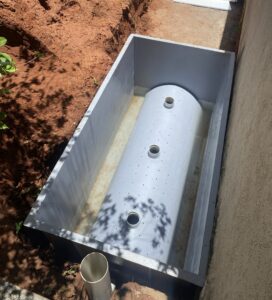
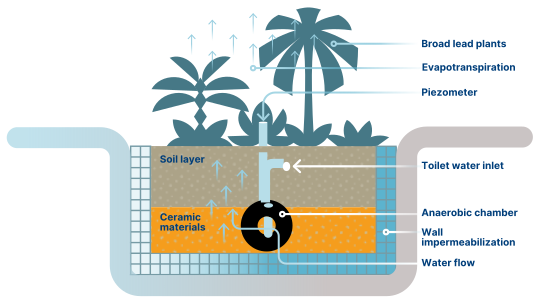
RPTU University of Kaiserslautern-Landau (RPTU) and the Nelson Mandela University (NMU) will jointly implement an evapotranspiration tank, a low-maintenance, plant-based system for treating household blackwater. The tank is fully sealed and filled with layered materials, topped with fast-growing plants that naturally draw and evaporate water. At its core is an anaerobic chamber that receives incoming wastewater. This chamber allows solids to settle and partially break down, protecting the filter layers from clogging. From there, the water flows upward through coarse recycled material, gravel, and sand until it reaches the topsoil. In the upper layer, most of the water is removed through plant uptake and natural evaporation, enabling a zero-discharge system. The surface vegetation not only drives water loss but can also be harvested to remove nutrients such as nitrogen and phosphorus stored in the plant biomass.
Goal
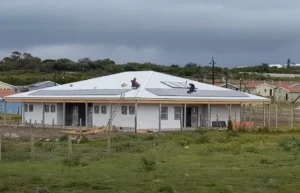
A demonstration system will be installed for two 4-person households in Ndlambe Ecosun village, South Africa. Covering a 16 m², it is designed to treat around 100 m³ of domestic blackwater per year. Its modular layout allows easy installation and scaling in distinct settings. Sludge accumulation is minimized by disposing of toilet paper separately, extending the interval between sludge removals in the anaerobic chamber to up to ten years.
The technology is widely adopted in countries like Brazil and Australia, but it has been limited so far due to the lack of standardised sizing and maintenance guidelines. DECIRE-WATER will address these challenges and evaluate potential methane emissions from the anaerobic chamber. If needed, mitigation measures, such as adding biochar to the filter media will be explored. The system’s sustainability is further strengthened by the option to use harvested plant biomass for resource recovery.
Type of solution:

Nature Based system composed by:
Anaerobic Chamber
Gravel-sand filter layers
Plant Evapotranspiration.

Off-the-shelf evapo-transpiration tank for blackwater treatment
Type of Monitoring:

Water quality control includes physical-chemical parameters
On-site monitoring of methane emission

Nutrient removal and safety uses includes nitrogen, phosphorus and pathogens analysis in the biomass produced.
Digital tools:

Interactive Dashboard

Early fault detection system